Nuclear Physics from Lattice QCD
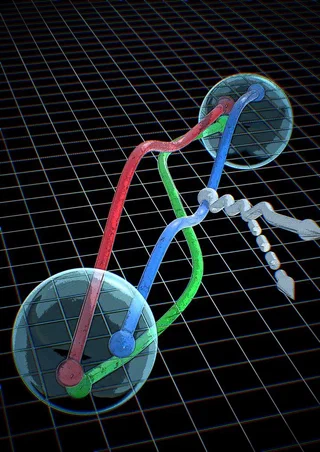 Artwork by Dr. Evan Berkowitz and Bart-W. van Lith.
Baryons, like the neutron and the proton, are composite particles made up of elementary quarks and gluons, interacting very strongly with each other. The strong interactions make the equations of the mathematical theory we use to describe quarks and gluons, namely Quantum Chromodynamics (QCD), impossible to solve analytically with pen and paper methods. Powerful numerical methods are required. We employ Lattice Quantum Field Theory methods, relying on Markov Chain Monte Carlo stochastic sampling techniques to evaluate a large-dimensional Feynman Path Integral.
With numerical computations we study how quark and gluons determine the fundamental properties of neutrons and protons, such as their weak interaction form factors and their strong interactions, which are important for nuclear fusion reactions fueling our Sun and nuclei formation in the early universe.
For more details see the webpage of the CalLat collaboration.
