
Matrix Model simulations using Quantum Computing, Deep Learning, and Lattice Monte Carlo
We study the two matrix models using deep learning methods and quantum simulations. We benchmark the results against lattice Monte Carlo simulations.

We study the two matrix models using deep learning methods and quantum simulations. We benchmark the results against lattice Monte Carlo simulations.
We provide evidence for partial deconfinement — the deconfinement of a SU( M ) subgroup of the SU( N ) gauge group — by using lattice Monte Carlo simulations. We take matrix models …
We study the confinement/deconfinement transition in the D0-brane matrix model (often called the BFSS matrix model) and its one-parameter deformation (the BMN matrix model) …
We study the bosonic matrix model obtained as the high-temperature limit of two-dimensional maximally supersymmetric SU($N$) Yang-Mills theory. So far, no consensus about the order …
Lattice field theories are a useful tool to define gauge theories in their non- perturbative regime. At the same time, the gauge/gravity duality conjectures that certain gauge …
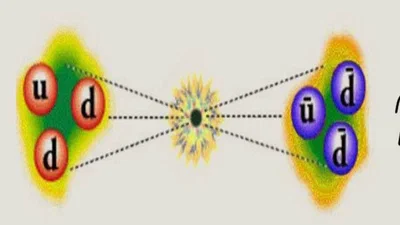
Fundamental symmetry tests of baryon number violation in low-energy experiments can probe beyond the standard model (BSM) explanations of the matter-antimatter asymmetry of the …
The fundamental particle theory called Quantum Chromodynamics (QCD) dictates everything about protons and neutrons, from their intrinsic properties to interactions that bind them …

Identify new dark matter candidates which are composite and made up of new elementary particles which could be discovered at the LHC

Develop Monte Carlo methods for Quantum Gravity via Holography